

Since ChatGPT was released, the volume of resumes submitted has skyrocketed—and that’s no exaggeration. Platforms like LinkedIn have seen a more than 45% increase in the number of applications in a year, reaching about 11,000 applications per minute. At the same time, data from Greenhouse shows that, since the launch of ChatGPT, some companies have seen the number of applications per opening grow by more than 100%, with recruiters literally “drowning in applications.”
In this new landscape, continuing to rely solely on CV screening and initial human interviews puts HR at a disadvantage. AI-powered interviews are no longer just a “cool innovation” but have become mandatory for anyone who wants to survive the tsunami of resumes generated (or boosted) by AI.
What has changed since ChatGPT
Before generative AI, applying for a job took time: tailoring a resume, writing a cover letter, filling out an application form. This naturally limited the number of applications a person could submit.
With ChatGPT and similar tools, this barrier has virtually disappeared. Today, a candidate can:
- Tailor your resume to dozens of job openings in minutes by using keywords from the job description (you’ve surely seen a resume that mentions a specific job title).
- Generate “personalized” cover letters with just a few prompts.
- Use paid AI tools that not only create the documents but also automatically submit applications to various websites while he sleeps.
Recent studies and analyses show that:
- The average number of applications submitted per person has increased by about 200–240% since the launch of ChatGPT.
- Some sources estimate that, by 2028, up to 25% of profiles or resumes could be partially or entirely “fake” or automated.
In other words: it’s not that there are many more qualified candidates—there are simply many more applications, period.
The “tsunami of resumes” and the collapse of traditional screening
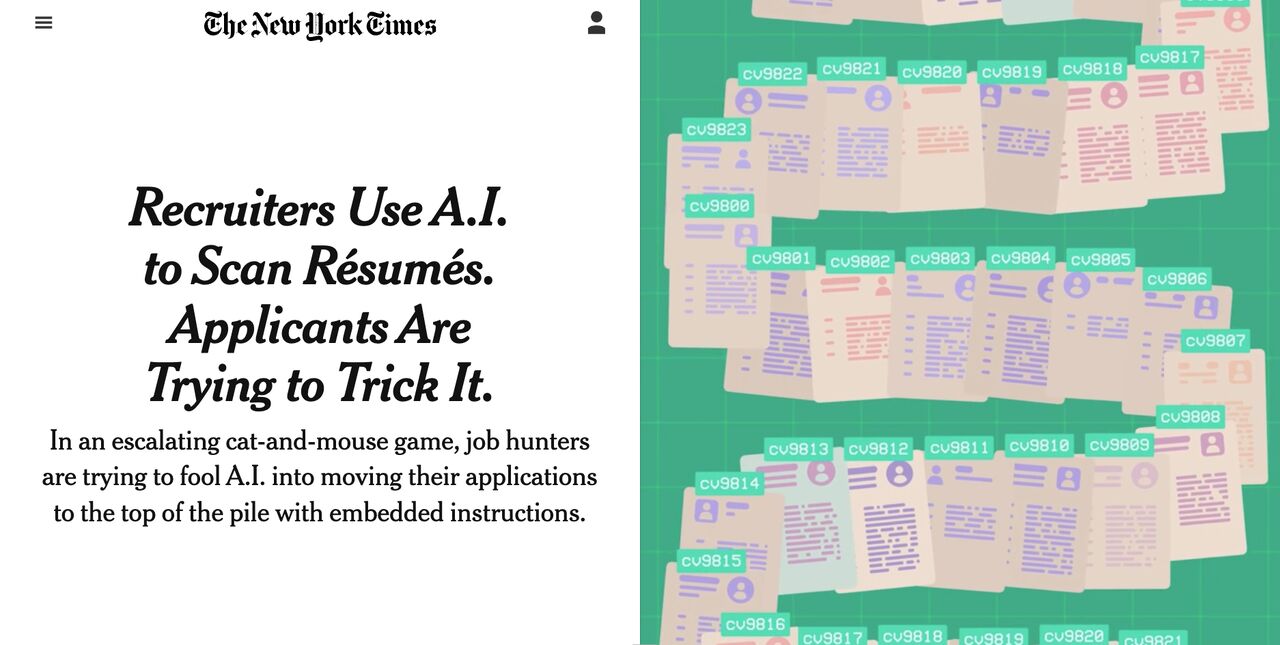
News reports and accounts from recruiters describe a veritable “tsunami of applicants”: entry-level positions receiving more than 1,200 applications in just a few days, forcing companies to take the job posting down because they are unable to process them all.
Some practical effects of this scenario:
- Overwhelmed recruiters: professionals report receiving hundreds of resumes within 24 hours for a single opening, making it impossible to read them all carefully.
- Resumes are becoming increasingly similar: Generative AI helps candidates “insert” keywords, resulting in many documents that look almost identical.
- It’s hard to tell who’s genuine and who’s just “spamming everyone”: Gartner and market analysts warn of a rise in fake profiles and mass automated applications.
Platforms like Greenhouse state bluntly: “Recruiters are drowning in applications,” and attribute this surge directly to the rise in popularity of ChatGPT. In this context, manual screening or screening based solely on resumes (even with ATS AI filters) becomes a structural bottleneck.
Why ATS + AI on resumes just doesn't cut it anymore
To handle the volume, many companies have increased their use of AI-powered ATS systems to:
- Filter by keywords, years of experience, and listed skills.
- Automatically sort resumes based on how well they match the job opening.
- Block duplicate applications or limit the number of applicants per opening.
The problem is that these AIs are also reading documents written (or optimized) by other AIs. It’s now a battle between the “candidate’s AI” and the “recruiter’s AI,” both of which are working with static text.
Clear limitations of this model:
- If a candidate knows how to use ChatGPT to write a perfect resume, they’re more likely to make it through the screening process, even without actual experience.
- Excellent candidates who aren’t as skilled at “selling themselves on paper” remain overlooked.
- The ATS still can't ask questions, dig into details, or check for consistency—it just reads what's already there.
Result: You trade a manual screening process for a relevance-based screening process. The volume is “under control,” but the quality of the shortlist remains disappointing.
The Case Against AI: Why Automated Interviews Are the Next Logical Step
In the face of this “tsunami of AI-generated applications,” more and more companies are adopting automated screening interviews—via chat or video—conducted by algorithms.
Some examples in the market include retail and food service chains using screening chatbots, with reports of a reduction of up to 75% in hiring time for operational roles.
The logic is simple: if resumes are inflated by AI, the only fair way to distinguish between those who actually have substance and those who just wrote well is… to ask questions and analyze the answers in depth. This is where models like Solu’s come in:
- The AI interviews 100% of the applicants who apply, immediately after they submit their application.
- It asks questions about real-life situations, concrete experiences, and ways of thinking.
- It provides a comparative overview of everyone based on their responses—not just their résumés.
Instead of AI simply analyzing the text of the resume, you now have AI assessing how the person thinks, explains, and provides examples.
Why AI-powered interviews have become a must (and will become increasingly common)
Given the surge in applications and the widespread use of AI by candidates, conducting interviews with AI is no longer just a “nice-to-have” but has become almost a matter of operational and strategic survival.
Real-time scaling: 100% availability without slowing down HR
With 500, 1,000, or 2,000 applicants per opening, it’s simply impossible for a lean recruitment team to:
- Read all resumes thoroughly.
- Conduct initial in-person interviews with more than 10–20% of the sample.
An AI-powered interview solution can:
- Automatically invite everyone to an initial structured conversation.
- Collect responses via text or voice, without having to rely on the recruiter's schedule.
- Consolidate everything into a comparable shortlist in a matter of hours, not weeks.
This gives HR the ability to cover the entire recruitment funnel—something that traditional screening no longer provides.
Distinguishing a “polished resume” from actual competence
When half the market is already using AI to write job applications, the resume becomes a highly polished marketing document. AI-powered interviews allow you to:
- Assess whether the candidate can describe in detail what they claim to have done on their resume.
- Ask follow-up questions when the answer is vague (“How did you measure that result?”, “What tools did you use exactly?”).
- Identify inconsistencies between what is written and what is said.
In other words: it’s the natural antidote to AI-inflated resumes.
Improving diversity and fairness in the process
When recruiters are buried under a mountain of resumes, they resort to shortcuts: College X, Company Y, “a profile that’s always worked.” This puts candidates with non-linear career paths or underrepresented groups at a disadvantage. By automating the first interview with AI:
- You give everyone the same opportunity to answer relevant questions.
- It reduces the importance of “the ability to write a good resume” and increases the importance of actual content.
- It opens the door to talent that was previously screened out during the initial resume screening process.
In this regard, using AI for interviews isn’t just a matter of efficiency; it’s also a matter of fairness.
How to integrate AI-powered interviews into your existing process
The good news: using AI-powered interviews doesn’t mean you have to throw away what your company has already built in terms of ATS and processes. A typical approach:
- Keep using your current ATS (Gupy, InHire, Greenhouse, etc.) for managing job openings, statuses, and basic communication.
- Integrate Solu as an AI-powered interview layer immediately after the application.
- Automatically invite all candidates to the interview using AI.
- Receive a prioritized shortlist based on the responses, either directly in the ATS or via an integrated dashboard.
- Use this shortlist as a basis for more in-depth interviews with recruiters and managers.
In practice, you turn the “black hole” between the application and the first interview into a structured, smart, and scalable process.
If candidates are already using AI, your recruitment process needs to use it too—the right way
In the post-ChatGPT era, it’s no longer a battle between “technology vs. humans,” but between those who can use technology to see real people amid the noise. Candidates are already using AI to boost their applications, polish their writing, and bypass superficial filters. If your recruitment process stops at reading resumes, you’ll always be playing catch-up. Interviewing with AI—as Solu does—is the natural response to this new game:
- You listen to everyone.
- Base decisions on actual responses, not just polished documents.
- It maintains the scale the market demands, without compromising on quality or fairness.
In this context, AI-powered interviews aren’t a luxury. They’re simply the new standard for anyone serious about recruitment in a post-ChatGPT world.





.svg)